Frøya in February
There is a specific kind of honesty that arrives in a Norwegian winter.
2026-09-17
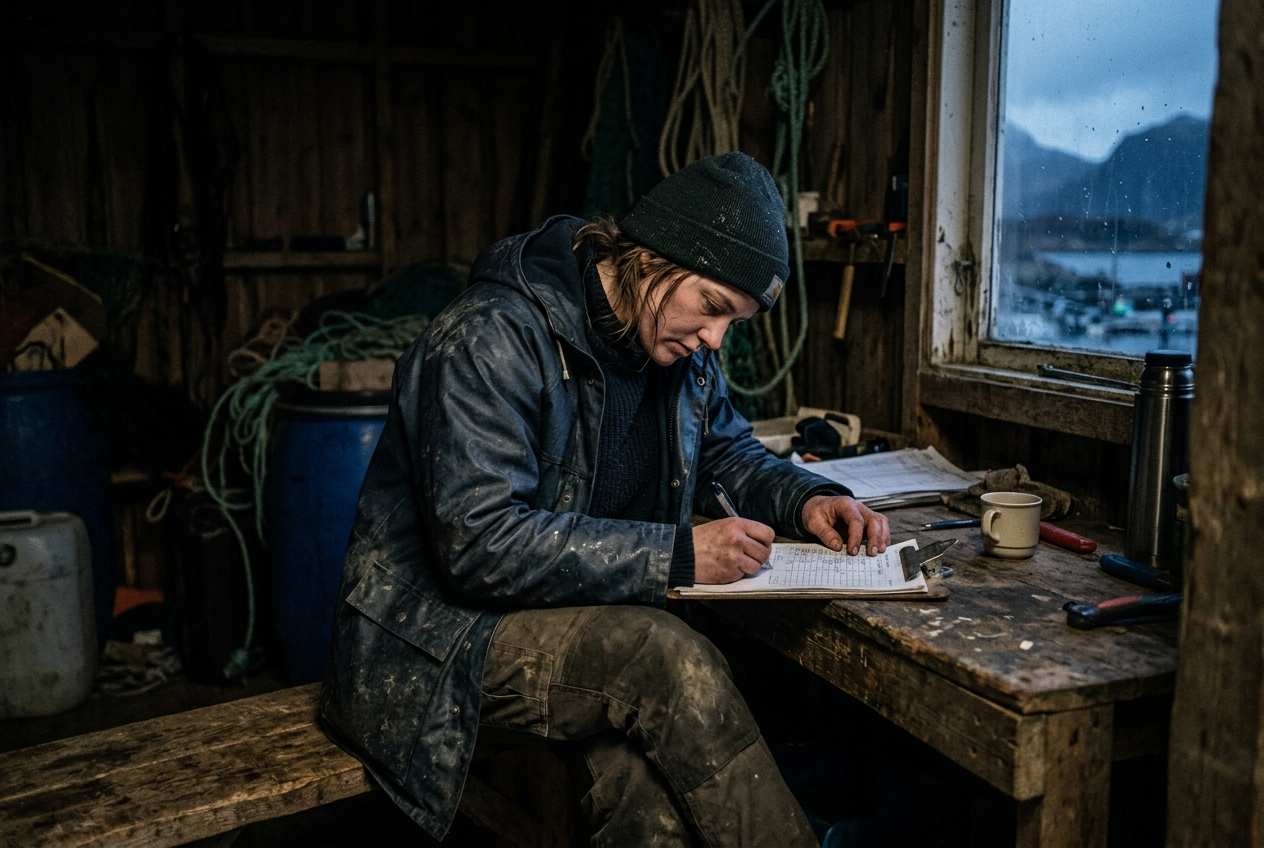
The paperwork at the end of a shift is not light work. It is cognitive and postural load stacked on top of a body that already spent eight hours doing something physical, and it is quietly eating into the recovery window you need most.
There is a version of hard work everyone recognises: lifting, hauling, standing on a deck in the wind, moving fast because the tide or the weather says you have to. Aquaculture in Frøya and Hitra has plenty of that, and most people who do it have made some kind of peace with the physical cost. You stretch, you eat, you sleep when you can, you know the job asks something of your body and you plan around it.
The part almost nobody plans around is what happens after the physical work ends and the paperwork begins.
Manual reporting, hand-written logs, spreadsheets filled in from memory or from a soggy notebook, feeding data into whatever system the operation uses this year: this is not "light duty" just because it doesn't involve lifting anything heavy. It is a second kind of work, layered directly on top of the first, and it asks your body and your nervous system to do something they are badly positioned to do well at that point in the day.
Think about the sequence. You've spent six to ten hours in cold, wet, physically demanding conditions. Your muscles are fatigued, your grip strength is down, your core has been stabilising awkward loads on an unstable surface for hours. Then you sit, or more often hunch, over a laptop or a clipboard to reconstruct exactly what happened, in the right units, in the right fields, correctly enough that it will hold up if someone checks it later. That is not recovery. That is a second workload, just a different kind.
The postural cost. After hours of physical labour, the body wants one of two things: to keep moving in ways that flush fatigue out of the muscles, or to lie down properly and let the nervous system downshift. Instead it gets asked to sit still in a static, forward-flexed position, often on whatever chair or crate happens to be nearby, for the twenty to forty minutes it takes to do reporting properly. That posture, stacked on already-fatigued postural muscles, is exactly the combination that produces the low back and neck stiffness people write off as "just getting older." It isn't age. It's an unrecovered body being asked to do a second static task it wasn't built to do at that moment.
The cognitive cost. This one gets less attention but matters just as much. Physical fatigue and cognitive fatigue draw from overlapping resources. After a demanding physical shift, the brain is not sharp, it is depleted, and depleted brains make more transcription errors, take longer to do the same task, and feel more stressed doing it. Anyone who has ever double checked a form three times because the numbers "don't look right" and they can't tell if that's the data or their own tired brain knows this feeling. It is real, it is measurable in how long the task takes on a hard day versus an easy one, and it is not a personal failing. It's physiology.
Put those two together and you get the actual pattern operators describe when you ask them honestly: the physical shift ends, but the body doesn't get to switch into recovery mode. It gets asked to do careful, seated, detail-oriented work while still fatigued and under time pressure, and only after that is done does the recovery window actually begin. Which means the recovery window is shorter than it looks on paper, because the "work day" quietly runs longer than the physical shift did.
Recovery isn't just rest, and it isn't just sleep. It's the process where the body actually adapts to the work it did: repairing tissue, clearing metabolic waste, resetting the nervous system so tomorrow's shift doesn't start from a deficit. That process needs a clear signal that the "work" part of the day is over. When reporting work drags on, hunched and stressed, right up until the moment someone finally eats dinner or goes to bed, that signal gets muddled. The body is technically off the clock, but it hasn't actually been told to stand down.
This is the same territory covered in "Why Recovery Is Not Rest" and "The Energy Budget": the body doesn't distinguish between "productive" stress and "unproductive" stress, it just tallies total load. A tired, hunched hour of data entry counts against the same recovery budget as an hour of hauling gear. If you're only accounting for the physical hours when you plan your recovery, you're underestimating your actual daily load, sometimes by more than you'd guess.
There's a piece published on the IPRESTANDA site looking at what the EU AI Act actually requires from Norwegian aquaculture operators on the documentation side. Worth reading if you run an operation, because the regulatory reality is that documentation and compliance work is not shrinking, it's growing. What that piece doesn't get into, because it's not its job to, is what that growing documentation load actually costs the people doing it, physically and cognitively, at the end of an already demanding day. That's the part covered here. The compliance conversation and the recovery conversation are usually kept in separate rooms, but for the person actually filling out the form after a ten hour shift, they're the same conversation.
You can't out-discipline biology on this one. The fix isn't "try harder" or "be more organised," it's structural.
Separate the two kinds of work physically if you can. Standing to do logging, even briefly, keeps you out of the worst compounded posture. Doing it somewhere other than the couch or the dinner table helps your nervous system register "this is still work" and then, once it's done, "now work is actually over."
Do the reporting as close to real time as possible rather than saving it all for the end. A few minutes of logging during a natural pause costs less, physically and cognitively, than forty-five minutes of reconstruction when you're depleted.
And be honest with yourself about what counts as your workday. If the physical shift is eight hours and the reporting is another forty-five minutes of hunched, tired concentration, your actual workday is eight hours and forty-five minutes, and your recovery window should be planned from that number, not the shorter one that looks better on paper.
The body doesn't care which part of the job felt like "real work." It just adds it all up.
Related notes
recovery
The Aquaculture Worker's Summer Problem
July is peak production season in Norwegian aquaculture. Long shifts, maximum physical demand, fatig…
recovery
Why Recovery Is the Training
Recovery is not what happens between training sessions. Recovery is the training.
recovery
Why Recovery Is Not Rest
A lot of high-output people think they understand recovery because they understand being tired.
Next read
There is a specific kind of honesty that arrives in a Norwegian winter.